The LUPUS EUROPE 2018 convention is underway in Leuven, Belgium and among the serious speeches on medical and psychological topics, we were delighted to be presented the beautiful (and very creative) word cloud entries in the Kick Lupus competition. All in all there were 35 entries to the competition, a great response!

The judges on the Kick Lupus panel had a hard time choosing who should win but we are delighted to say that our winner is Sara Woods from the UK.

In addition to her beautiful piece of art, Sarah has written a text with her story and a poem. We are so glad she was able to come to the convention and share her personal story with us. We are sure that her artwork and words will resonate with many of you.
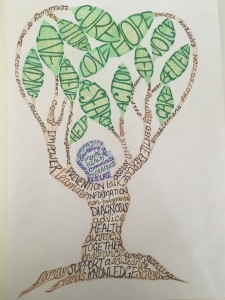


Here is what Sarah had to say…

I think in order to fully understand my cloud you need to hear my own personal Lupus story which begins before I was even born.

In the late 1970’s my grandfather, Arthur was diagnosed with Systemic Lupus Erythematosus (SLE). Due to the lack of knowledge about Lupus at the time, my grandfather was diagnosed when he was in the later stages of the disease. He was asked to attend Doctors lectures in order to help spread awareness and knowledge of the disease so I know he wouldn’t mind me speaking of him to you today.

Sadly my grandfather passed away in 1980, only a few years after he was diagnosed, due to complications associated with Lupus, leaving behind two daughters (one of which is my mum) and a wife – he was only 53 years old.

I was born 18 months later. Though I never knew my grandfather I grew up being fully aware of the massive void his death had left in the family.

Fast forward 15 years or so and we think I first became unwell with SLE in my late teenage years. I would feel fatigued, achy, run down, would experience a swollen, ulcerated mouth and regular ear infections.

Despite visiting my GP and dentist multiple times in an attempt to get to the bottom of my symptoms, and mentioning on numerous occasions that there was a family history of Lupus, I wasn’t properly listened to and so consequently didn’t get a confirmed diagnosis until earlier this year when I attended a GP appointment armed with a lot of research which I believed pointed to Lupus – I was correct.

I have been receiving treatment for my Lupus since May this year and I am already feeling so much better in myself. I am managing to work full time an NHS Mental Health Nurse, whilst also being able to cope with caring for my 3 children – all of which was becoming a near impossible daily challenge for me before my diagnosis.

So for me having a diagnosis has been life changing. Yes, it has been a blow for the family to find out that I also have the same condition as my grandfather, but at least I am getting some level of normality back in my life due to adequate symptom control after battling on and on with the symptoms for so many years.

Sadly I am well aware that I am far from unique when it comes to getting a timely diagnosis and appropriate treatment. I feel that in order to truly ‘Kick Lupus’ this needs to be addressed, hence my decision to spend time earlier this year when I was off work recovering from a Lupus flare creating my word cloud.

I have always been a creative person and I actually use art as a tool to help people with mental health problems in my place of work. I enjoy drawing, writing and music as I believe they all hold therapeutic elements that can promote healing – this word cloud certainly became part of my own healing process when I crated it.

I chose the theme of a tree to ‘Kick Lupus’ as it promotes the notion of growth, life and renewal. Trees also have strong roots to ground them and to provide stability as well as the need to be well fed and nurtured with its many networks in order to develop well and thrive. I think all of these elements mirror the humanistic requirements that are needed to help someone who has a diagnosis of Lupus.

I designed the tree to deliberately shape into a heart with no beginning or end so that each element within the tree becomes connected and dependent on the next in order to thrive no matter how big or small.

I deliberately coloured the head of the tree person in a blue shade as I personally could often feel quite ‘blue’ in my mood and I feel that adequate mental health resource is essential to ‘Kicking Lupus’.

The idea that the tree person is placed within the shade of the leaves of the tree comes from the notion that due to my photosensitivity I seem to spend a great deal of time under the protective shade of these gentle giants. I have attempted to make the tree person sexless as I feel that at times males can be underrepresented with regards to Lupus.

I added a subtle piece of my grandfather to the tree as well – the texture on the leaves was created by rubbing a pencil over an embossed stamp on the cover of one of his old books that has been passed on to me, so my grandfather is effectively helping to protect me within the leaves.

All the words within the tree have been strategically placed so that they have meaning that relates not only to the tree but also to the placement within the tree and it’s ultimate aim to ‘Kicking Lupus’.

When developing this tree I was all too aware of the fact that on the outside for many years I looked like a fit, health young woman I wasn’t properly seen or heard by health care professionals, this led to a significant delay in diagnosis and prolonged suffering, so I have included the words ‘see’, ‘listen’ and ’believe’ for this reason. I have also written a poem about what this can feel like which I would like to share with you…


The Butterfly and The Hurricane

Look how she glows! Colours radiating!

Wings proudly displaying a lifetime of scars from unspoken wars,

they mingle within her unique design and become one.


See how she flies! She’s at the prime of her life!

Spreading her wings and sharing her finds – she’s divine!


All too soon, war resumes, her battle persists.

Into the dark and out of control,

she clashes with forces that refuse to desist.


To see her she’s dancing, it’s glorious to see,

but inside she’s fighting what can never be seen.

People pass comment on this beautiful sight,

never really seeing her personal plight.


Out in the open she sees other’s around,

dancing the same dance on this twisted merry-go-round.

Beautifully unique, yet tragically the same,

all caught within this cruel hurricane.


At times it’s power slows and her confidence grows,

she begins to believe she can fly without its control.

She tries to mend….but all too soon that familiar trend,

the vortex that consumes returns.


And so her beautiful, silent, war-dance continues,

looked upon by many, yet truly seen by few.


Live Facebook Feed

Comments Box SVG iconsUsed for the like, share, comment, and reaction icons

🦋 Our final #EULAR2026 recap is here!

🌍 We started the day in the session “Next-Gen Treatments: CAR-based Therapies and Beyond in RMDs”, chaired by our Chair, Jeanette Andersen.

The session explored new therapeutic frontiers, but also the responsibilities that come with them. For us, one message remains essential: innovation must be developed with patients, not only for patients.

💬 Jeanette also delivered the PARE Meet the EULAR Expert session “AI as a Partner in Care: Empowering the RMD Community with Information”.

The room was packed, showing the strong interest around #LupusGPT and #EasyLupus as powerful patient-led, validated digital tools that help people living with lupus access reliable, understandable information in almost any language.

The many questions from attendees showed how relevant this topic has become for healthcare professionals, researchers, patient representatives and the wider rheumatology community.

🧬 We also followed the “How to treat SLE” session with George Bertsias, who focused on current and evolving approaches in lupus care, including treat-to-target strategies, remission or low disease activity, and the importance of reducing long-term organ damage.

🦴 Later, Edward Vital led the Meet the EULAR Expert session on “Management of joint involvement in systemic lupus”, a topic that matters deeply to many people living with lupus.

💜 A special highlight of the day was seeing Lupus Europe’s work recognised during the EULAR highlights another year.

These sessions take place at the very end of the Congress and bring together the key takeaways from #EULAR2026. Importantly, there are no parallel sessions at that time, which means there is no competition with other talks, and most of the attendees are in the room.

🙏 Thank you to everyone who followed, shared, visited us, spoke with us and supported us throughout #EULAR2026.
... See MoreSee Less

Image attachment
Image attachment
Image attachment
Image attachment
Image attachment

🦋 We continue bringing you our #EULAR2026 congress recaps!

The third day was another intense day for Lupus Europe, with patient-led research, emerging science and important conversations about lived experience, as well as ongoing and potential projects to improve lupus care.

🧠 One of the highlights was Alain Cornet’s poster on mental health trajectories in lupus: “Mapping mental health trajectories in lupus: patient-identified inflection points and support opportunities from a European patient panel”.

Presented by Ricky Chotai on Alain’s behalf, this patient-led work explored how people living with lupus and mental health difficulties understand mental health across the lupus journey.

Yesterday, we already told you more about this poster and its key messages, in case you missed it!

🦠 On 5 June, we followed emerging science on the microbiome, and the Meet the EULAR Expert session “Management of joint involvement in systemic lupus” with Professor Edward M. Vital.

📊 Disease activity measurement in SLE was another important theme, especially how clinical targets can be better aligned with lived experience.

♀️ Menopause was part of the day’s conversations, highlighting the importance of asking about it routinely and recognising how hormonal transitions may shape symptoms and quality of life.

🌍 Across the day, one message kept returning: better lupus care needs science, but also communication, patient priorities and tools that help people say what matters most.

That is exactly why tools such as the Lupus Consultation Cards matter. They are available in 20 languages and help people prepare for their lupus appointments by organising symptoms, concerns and top questions in advance. Check them out here: www.lupus-europe.org/lupus-consultation-cards/

💬 We kept connecting these discussions with #LupusGPT and #EasyLupus, because access to understandable, reliable information before and after consultations is part of helping people take a more active role in their care.

🥳 And we celebrated Jeanette's birthday!

😃 Want to know more? Catch up on the latest insights from the congress in our #EULAR2026 Recap Webinar, which you can watch here: www.facebook.com/LupusEurope/videos/2035644043691260
... See MoreSee Less

Image attachment
Image attachment
Image attachment
Image attachment
Image attachment

😃 Last week at #EULAR2026, we presented POS0246-PARE, “Mapping mental health trajectories in lupus: patient-identified inflexion points and support opportunities from a European patient panel”.

The poster was presented by Ricky Chotai, Lupus Europe Board Member, on behalf of Alain Cornet, Lupus Europe Finance Lead & Organisation Coach, and lead author of this work.

✅ This patient-led qualitative work explored how people living with lupus and established, currently stable mental health difficulties understand the trajectory of mental health across the lupus journey.

‼️ Based on our patient panel conducted in Portugal with 8 adults living with lupus, the work identified key moments when support may matter most: diagnostic uncertainty, early disease phases, fluctuating symptoms, and communication with healthcare professionals.

🔴 One of the key messages is clear: mental health in lupus should not be seen only as an isolated symptom or crisis. It can be shaped over time by interactions with uncertainty, communication, and care structures.

The findings point to practical opportunities for support, including earlier acknowledgement of mental health concerns at diagnosis, normalising mental health discussions in lupus care, clearer communication during periods of uncertainty, peer support, and integrated psychosocial support throughout the disease course.

💫 Congratulations to Alain Cornet for this outstanding poster and to all authors: Zoe Karakikla-Mitsakou, Jeanette Andersen, Ricky Chotai, and Alain Cornet.

Read the abstract:
distribution-congress.eular.org/from.storage?image=15rRXWmdOAJ77zPlkD-rQtl85j9jAymUnt6XfjsO2C9rls...
... See MoreSee Less

😃 Last week at #E

💜 Thank you to everyone who attended our EULAR 2026 Recap Webinar and joined us to look back at one of our most exciting congresses in recent years.

🤩 #Eular2026 has been intense, inspiring and full of moments we will remember.

Over the Congress, Lupus Europe contributed to and followed an incredible amount of work:

✅ 7 presentations as speakers
✅ 3 sessions chaired
✅ 66 sessions attended
✅ 318 presentations followed
✅ All the interviews you have been able to see in this webinar

But it is not only about numbers.

🌟It is also about the people behind them: the commitment, the humour, the hugs, the shared tiredness, the late nights, the conversations between sessions, and the spirit of this amazing Lupus Europe family.

What makes our work possible is not only the support we receive from our community, partners and friends.

🥰 It is also the energy, attitude, and generosity of our volunteers, who give their time, expertise and heart to Lupus Europe.
... See MoreSee Less

LUPUS EUROPE Uniting people with Lupus throughout Europe
Send