 Zoe Karakikla-Mitsakou
Welcome back to our blog series on National Member News!
We are excited about getting our National Member news out to the world! We want more people to find out what it is happening in each country and each member organisation! We caught up with Aldevina Sturiene from Lupus Lithuania who talked to us about the great work the organisation is doing, the needs of lupus patients in Lithuania, COVID19 and so much more!
How do you keep in touch with or have contact with your members?
We connect with our members through a closed Facebook group. We don’t have a website yet, although this is something that we have been working on and really want to do. We have a designer who is ready to design the website and we have talked to a number of doctors who will help us ensure the information on the website is accurate; due to the pandemic however, we have had to put this project on hold.
Before COVID19 we had two conferences every year, one in May for World Lupus Day and one in the Autumn. They were always in-person events and presented a great chance to keep in contact with our members, catch up and keep the group invigorated. Lithuania isn’t a very big country, but we ensured the conference in May took place in the East of Lithuania and the conference in the Autumn always took place in the West of Lithuania. The conference that took place in the Autumn never had a permanent home – we would go from city to city year to year for this conference!
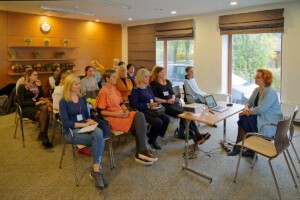
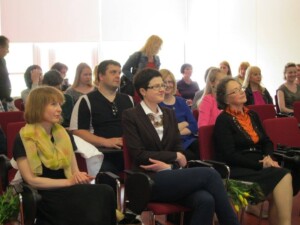
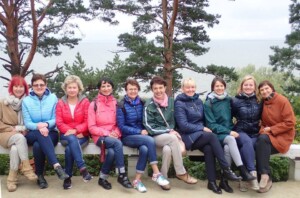
Photos of Lupus Lithuania in-person meetings
Did you have any special meetings or webinars during the past year (World Lupus Day, Rare Disease Day, Annual General Meeting etc)?
We did have some meetings during the past year. We had a meeting for World Lupus Day and we also had our regular Autumn meeting, but they were a bit different this year. We did not invite guest speakers this year and the meetings were held online. They were a chance to catch up with group members, check on everyone’s wellbeing and inspire each other through this tricky time.
Has it been difficult to keep connected with your members during the Covid19 pandemic?
Yes and no. People have been quite busy during the pandemic, but in our Facebook group they have always had a chance to ask any questions they had and get answers so it has been very active still.
To become a member of our Facebook group you have to answer a series of questions and be verified. We currently have 585 members. A lot of them are members of the Lithuania Lupus Group too and pay membership fees etc, but some of them are associated members who have joined the Facebook group but are not members of the Lithuania lupus group.
We also have many Lithuanian members who live all around Europe, members of the Facebook group don’t have to live in Lithuania to join! Some Facebook group members who are Lithuanians, living in other EU countries regularly travel to Lithuania from around Europe to see specialists for their lupus. They did experience some difficulties doing that during the pandemic, because of the travel restrictions.
Have there been any circumstances during the pandemic that changed the way of living with lupus?
Yes. We had a lot of difficulties when the pandemic first started. Plaquenil was the first issue; all Plaquenil was diverted for covid treatment initially and lupus patients found it very hard to access Plaquenil. We took part in online conferences about this issue with the Healthcare Minister and we explained that Plaquenil is the main treatment for lupus. We worked very hard to ensure people with lupus had access to Plaquenil again. It took a few months, but we have had no difficulties accessing Plaquenil since.
Lupus patients also experienced major difficulties accessing biologic treatments. In the city of Klaipeda, the rheumatology department closed because almost all doctors got COVID. So suddenly there was no possibility for anyone to have Benlysta infusions. In Vilnius (the capital of Lithuania), there were issues as well and patients did not have access to Benlysta or to infusions of other biologics. This was a big problem for a lot of people.
We worked on this issue; we corresponded and collaborated with the Healthcare Minister and with GSK on this. In the end patients got access to subcutaneous self-injectable treatment with Benlysta at home, as a solution. This was almost a positive of the pandemic, the fact that patients were able to access self-injectable Benlysta treatment as a result of the major difficulties we had with accessing infusions of Benlysta and other biologic treatments in hospital during the pandemic.
It’s interesting; self-injectable Benlysta treatment was initially thought to be too expensive and that’s why patients couldn’t access it in Lithuania. Since there were difficulties accessing infusions of Benlysta however, due to the pandemic, the situation changed. Interestingly the cost of self-injectable Benlysta may appear to be higher compared to the cost of IV Benlysta in hospital, but if the calculations include travel time to hospital for the patients, time lost from work for patients in order to attend hospital, the cost of paying for the healthcare workers’ time etc the cost between the two treatments is almost equal. In Lithuania now, patients who are new to Benlysta receive treatments in hospital so they can be closely monitored at the start of their treatment. Once stabilised, they can have Benlysta treatment at home.
Has Digital Health improved or changed in your country?
Yes. We now have online or telephone appointments; they became a possibility with the pandemic. We did have electronic prescriptions pre-pandemic, but the system has improved a bit with the pandemic.
We believe that for a lot of people digital health and online or telephone appointments can save time for patients and reduce the possibility of covid transmission. However some patients do want to have in-person appointments with their doctors. We did surveys on this and found that there appears to be a preference among older patients and patients with lower education levels towards in-person medical appointments versus online or phone appointments.
What would you most need as support in your country for lupus?
That is a difficult question! Financial support may be important for us. Close to 75% of patients in our group have a disability. This has an impact on people’s incomes. There are 3 different levels of disability, corresponding to different levels of financial support for that disability but that government aid is not much. So, when we organise conventions or conferences our members may have to travel a long way and they have to pay their own way to attend; that can be difficult.
As a group we need funding to organise large events such as conferences. For conventions or conferences, we want to be able to invite specialists as speakers, but the truth is a lot of specialists charge per hour plus their travel expenses to speak at events. That means we have to be resourceful and find speakers for whom we only pay travel costs, but even that can come at a substantial cost for our organisation.
Is there anything you think Lupus Europe could help your organisation with?
We hope to be able to have an in-person conference next year for World Lupus Day. So yes, absolutely we might ask Lupus Europe for help in paying for speakers for that conference because, due to COVID, there are a lot of questions and issues that need to be discussed at this convention.
There is a lack of access to psychological support for people with lupus in Lithuania; that is an issue we want to work on and might need help with.
Reimbursement of sun care protection products is a big issue for us as well. We would like to get access to information we can present to the Ministry of Health about this issue in terms of why it is important for lupus patients to have access to sun protection creams. The Healthcare Ministry here has said they do not reimburse cosmetic products, but sun protection is not a cosmetic issue for lupus patients. We are working on this and trying to find a solution for lupus patients; we would like to work with Lupus Europe on this issue.
Another issue we are facing is that treatment with Plaquenil for patients with discoid lupus is not reimbursed in Lithuania. We have investigated this and have found studies indicating that if discoid lupus isn’t treated, it can go on to develop into full blown SLE for a percentage of people. We want to find more evidence about this and to look at the evidence basis behind Plaquenil treatment for discoid lupus patients. We would like to work with Lupus Europe on this important issue, so we can present our findings to our government bodies and, hopefully, effect change.
Is there any topic/theme/area that you think Lupus Europe should focus on, on something where European collaboration would make sense?
Yes! We want all patients from all around Europe to get access to the same treatment and to have the same reimbursement for sunscreen protection. We also want patients not to experience discrimination and we want bureaucracy to be decreased. We would also love to work on shortening the time it takes to see specialist doctors, as lupus patients often have to wait too long to see specialists.
Are you aware of the Lupus Europe Member Capacity Building Program?
Yes!
Could you tell us a bit about a dream you have as a group?
We want to become like one big family! We also want more to people participate in the group, as one big team that works towards a common goal!