 Zoe Karakikla-Mitsakou
Welcome back to our blog series on National Member News!
We are excited about getting our National Member news out to the world, so more people can find out what it is happening in each country and each member organisation! We caught up with Ram Blass from Inbar who talked to us about the wonderful work the organisation is doing, the needs of lupus patients in Israel, lupus and sun sensitivity and much more!
How do you keep in touch with or have contact with your members?
Most of the time we keep in touch through whatsapp and facebook. We have two facebook groups for lupus specifically; one of those groups has over 1500 members and the other one around 1000 members. Sharon moderates one of the groups and does a very good job of it!
Did you have any special meetings or webinars during the past year (World Lupus Day, Rare Disease Day, Annual General Meeting etc)?
Absolutely! We run webinars 3 times a year on lupus specifically and we did that last year too. In the past year we also had webinars on covid19. We regularly also run webinars about rheumatic diseases in general.
We have to say that within our organisation, INBAR, we also have a group about scleroderma, as a rare disease, and this is building up at the moment. Another group within our organisation that we also have is a group on Familial Mediterranean Fever (FMF). We therefore regularly run webinars on those conditions too and many others!
Has it been difficult to keep connected with your members during the Covid19 pandemic?
Most of our members have been home during the pandemic. It wasn’t very hard to have a connection with our members during the pandemic. We used Zoom, Facebook and whatsapp and connected regularly with our members through those mediums; it wasn’t hard at all to stay connected.
We also have e-mails for all of our members and we regularly connect with our members through e-mails as well.
During the pandemic we established two lupus specific support groups; they are divided according to age, one is for over 45s for example. We run the support groups over zoom. Both support groups meet weekly for 12 weeks and after those 12 weeks they have monthly meetings. Th
Have there been any circumstances during the pandemic that changed the way of living with lupus?
Yes, absolutely. One big difference that naturally came about with the pandemic is that everyone is much more helpful. People are also more reluctant to leave their houses and the pandemic made things that much more difficult for everybody in that way. People with autoimmune conditions like lupus were a lot more careful during the pandemic. We, as an organisation, warned people many times to protect themselves against covid and be careful because it can be very difficult if lupus patients catch covid19. People were scared for a long time, but now everything seems to be settling down and restrictions easing.
We have had a lot of questions come to us about vaccination against covid. In fact, people still have questions. We had a webinar on vaccination specifically, one of the professors spoke and said it’s important for everyone to have the vaccine. He also able to advise about specific medication and the vaccine and encouraged people to ask their own doctor about the vaccine. We have found that most lupus patients that are INBAR members have taken the vaccine.
Has Digital Health improved or changed in your country?
Yes! Digital health has changed over the past few years, it has greatly improved. We are connected to our national health service now and we can receive the results of tests online for example! Patients also have the choice to communicate with their doctors by phone or by zoom or in person. Electronic prescriptions are also available, and they are widely used. Everything has changed, and we think this will be maintained in the future, as the systems are there now to accommodate these changes.
What would you most need as support in your country for lupus?
Although things have improved greatly in the last few years, we always appreciate receiving all the latest news and updates. We believe the synergy of working together is very important. Working together is so much better than each organisation and each country working alone.
Is there anything you think Lupus Europe could help your organisation with?
We are a very diverse country in terms of the languages spoken here. Everyone speaks Hebrew, though not everyone speaks it fluently, and a lot of people speak English, Arabic or French. We would be very happy if there could be translations of important documents about lupus and information on lupus in Hebrew. It would be of important benefit to us and our members if we could receive some information in Hebrew.
Is there any topic/theme/area that you think Lupus Europe should focus on, on something where European collaboration would make sense?
Yes, we would want a central database of information to be created that could be open to all members, like a library of information. Each member could contribute and be able to access information through this library.
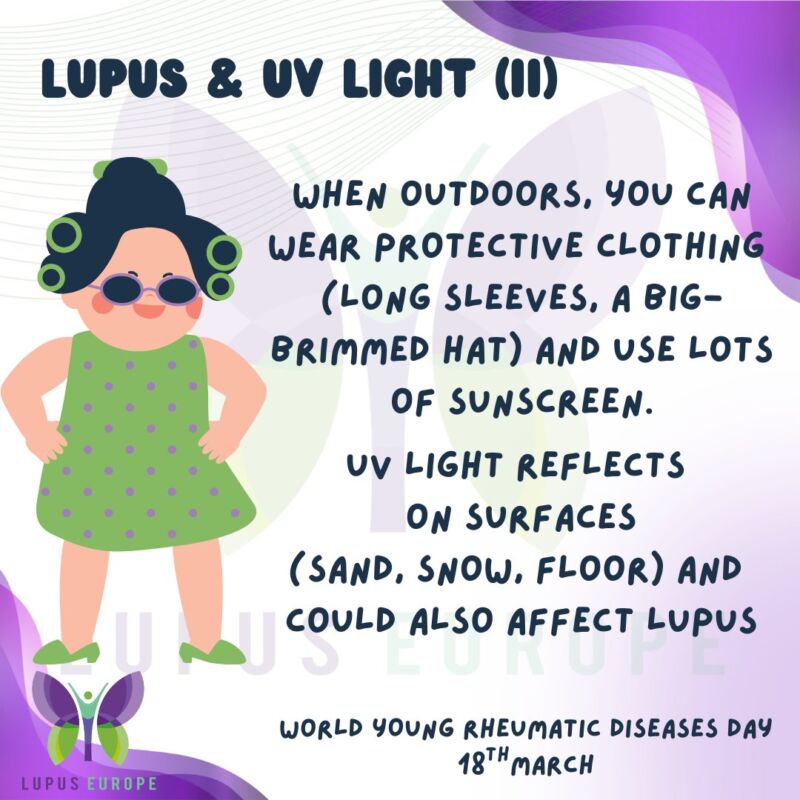
We would be very keen to have Lupus Europe focus on issues like sun sensitivity of lupus patients and also pollution, as we believe pollution is involved in autoimmunity and lupus.
Are you aware of the Lupus Europe Member Capacity Building Program?
No! But now we are!
Could you tell us a bit about a dream you have as a group?
The dream of our group is that everybody will be healthy. We know that this is impossible, but an important dream for us is for everyone to be in remission. We believe this to be possible and we hope a lot more new medication will be available in the future for lupus and for other autoimmune diseases.