 Zoe Karakikla-Mitsakou
Welcome back to our blog series on National Member News!
We are excited about getting our National Member news out to the world, so more people can find out what it is happening in each country and each member organisation! We caught up with Anne-Britt Eide and Cathrine Hjelmeset from the Norwegian Lupus Group, who talked to us about the wonderful work the organisation is doing, the needs of lupus patients in Norway and much more!
How do you keep in touch with or have contact with your members?
NRF, Norsk Revmatiker Forbund (Norwegian Rheumatic Organisation in English) is the mother organisation for Lupus Norway. We are three resource people in the Board. Lupus Norway has 600 members, but there are 2-3000 people living with lupus in Norway.
Norway has 15 counties and some of the counties have their own lupus group or a lupus contact for patients living in these counties. One of our Board’s main goals is to keep in touch with these groups and lupus contacts.
We have a website https://www.revmatiker.no/diagnose/lupus. This has not been updated for a while, but we aim to change that this year. All members who are registered with the organisation can be contacted electronically.
We publish two newsletters a year and we send them to all our members by e-mail, in pdf format.
There is also a closed Facebook group for lupus patients in Norway. This was created by a lupus patient. It is a private group and has nothing to do with our organisation (NRF). In the Facebook group, people can join regardless of whether they are a member of the NRF or not. The group is closed and only for patients, no healthcare professionals or family members are allowed, so it is a good platform for patients to share information, discuss issues and feel comfortable with each other. If as an organisation, we have an important announcement to make, we can share it with this Facebook group as well so that is another way to reach our members.
Did you have any special meetings or webinars during the past year (World Lupus Day, Rare Disease Day, Annual General Meeting etc)?
Yes, we did! We had a Convention in October 2022 for all our members! Unfortunately, few members wanted to join an in-person Congress, so we opened the Convention up to members of the Norwegian Sjogren’s Association as well. We had a joint 2-day Congress which was very successful. In those two days we talked about what we could do to reduce our pain, improve our quality of life and focus on ourselves. Cathrine Hjelmeset (Norwegian Board member) was able to share her story with the Convention delegates.
We also all had a group activity where we walked for one hour with alpacas! This motivated people to engage and take part in physical activity!
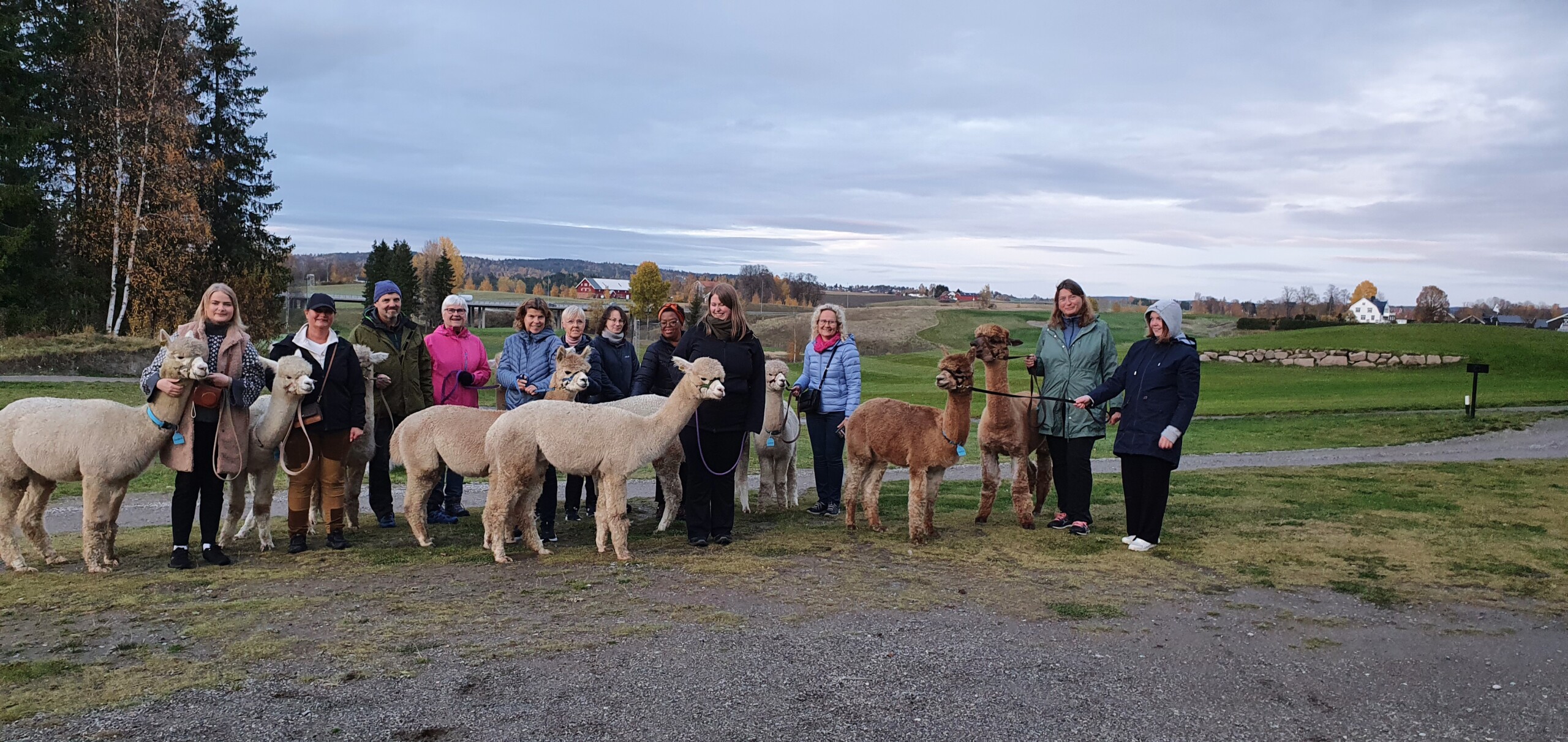
Picture of participants during the group activity with the alpacas
Has it been difficult to keep connected with your members during the Covid19 pandemic?
It was really difficult to keep connected with our members during the COVID19 pandemic. We really didn’t have an active group in 2020/2021 because of this. Communication with and from our members drastically decreased during the pandemic. We were also meant to have a Conference at Oslo University Hospital, but this was cancelled because of pandemic rules.
On the other hand, a number of webinars became available during the pandemic which was very positive. For example, the University Hospital in Oslo had a webinar on Zoom and for this webinar, it was arranged that members of our organisation could send in questions beforehand for the doctors; those questions were answered during the webinar.
NRF (i.e. the Norwegian Rheumatic Organisation) had webinars too and members of the organisation were able to join it. The topic of those webinars was the organisation, news, a peer support network within the organisation et cetera.
Have there been any circumstances during the pandemic that changed the way of living with lupus?
Not much changed in the way of living with lupus in Norway during the pandemic. Lupus patients stayed at home at first, like everyone else; we were afraid at first. But we had access to all medication, we had a good supply of hydroxychloroquine, and our general medication access remained the same as before.
Lupus patients were also able to go to hospital for in person appointments with their rheumatologists during the pandemic. To go to hospital, people had to answer a covid safety questionnaire and, if that was ok, they could then go in for their in-person appointment. As an alternative, there was also an option for digital health appointments and digital contact with doctors for people.
Has Digital Health improved or changed in your country?
Yes, it has! Digital health drastically changed in Norway right after the pandemic first broke out and the changes were very quick, it seems like big changes rolled out within a few weeks almost. The organisation that oversees the digital health rollout in Norway, launched an app – Health Norway – where people can see their Covid19 test results et cetera. They are now working to expand this app and make it so that people can access their regular blood test results through the app as well; this is now in the testing stages.
What would you most need as support in your country for lupus?
Funds! But also, GPs in Norway need to have more knowledge about lupus. In some Norwegian counties people are not diagnosed for a long time; diagnosis can take such a long time and not everyone is lucky to have a rheumatologist or GP that knows about lupus. That’s one thing we are hoping for, increasing awareness about lupus amongst GPs and healthcare professionals.
We also desperately need a way to increase our organisation’s sustainability; we need to have more lupus patients who are interested and engaged join our organisation’s Board. People want to participate as members, but we really need people who are interested in being on the Board as well to ensure our organisation is sustainable! We do have a young person who joined the Board this year, but we do need and want more people to join!
We have an ambitious plan for the year! Two of our delegates are going to the Lupus Europe Convention in Lisbon in April 2023. We are going to take the information from the Convention as inspiration and we will have a small Convention in the Autumn of 2023 for our members. Our aim is to take the information to the fifteen counties of Norway, focusing the Convention around the same topics as the Lupus Europe Convention but aimed at our national groups and focusing on building contacts in the counties of Norway and increasing engagement!
Is there anything you think Lupus Europe could help your organisation with?
That’s a difficult question! We’re hoping the Convention in Lisbon will help our delegates to organise the Convention in Norway in the Autumn of 2023. We are going to use the Lupus Europe Convention in Lisbon, as an inspiration for our Convention in the Autumn 2023!
We would also like to have an article about Lupus Europe in our organisation’s newsletter, so more of our members can find out about Lupus Europe, what the organisation does, its Conventions et cetera.
Is there any topic/theme/area that you think Lupus Europe should focus on, on something where European collaboration would make sense?
Yes! It would be great if Lupus Europe could focus on new medication, developing new medication for lupus patients. It would also be great if Lupus Europe could give information about lupus to doctors, help to raise awareness of lupus and to improve doctors’ knowledge around lupus.
Are you aware of the Lupus Europe Member Capacity Building Program?
No!
(Now informed!)
Could you tell us a bit about a dream you have as a group?
We have a very big dream of arranging a huge Conference on lupus in Oslo or another region in Norway for doctors and patients to come together. I (Anne Britt) attended a Conference for doctors and patients in New York in 2010; it was a big 4-day Conference with many doctors and patients from around the world and it was excellent! My dream is that maybe the lupus organisations of Sweden, Norway and Denmark could come together and have a joint Conference for patients and doctors together on lupus!