Patients take universal health coverage into their own hands

150 patients’ advocates from 48 countries are meeting in London to discuss how innovation can help achieve universal, patient-centred and sustainable access to healthcare around the world.

Patients’ groups, academics and health organisations will meet at the 7th Global Patients Congress, from 9-11 April, to share innovative best practice, research and to highlight specific examples of how to improve healthcare access across countries and contexts. Topics will include new approaches to community mobilisation, health professional-led innovation in disaster and conflict areas, strengthening health systems and patient involvement in drug development.

The adoption of the UN Sustainable Development Goals has pushed universal health coverage (UHC) – where all people receive the health services they need, without suffering financial hardship when paying for them – to the front of the health agenda. Every UN member state has agreed to ‘ensure healthy lives and promote well-being for all’ by 2030, which gives patients the timescale and the means to hold them to account. Many patients are taking the challenge of universal health coverage into their own hands by sharing new ideas which already improve healthcare in their communities.

Innovative approaches are improving patient experience, choice of treatment options and outcomes across the world. New examples are constantly surfacing: virtual patient communities now provide greater access to information and peer support, crowd-funding helps patients pay for the research they want to see, and social media helps to normalise different conditions and reduce stigma. These developments are changing the face of healthcare. Patients are more informed, more involved, and more engaged in working collaboratively with others to change health systems for good.

Jolanta Bilińska, Chair of the International Alliance of Patients’ Organizations, said:

‘History will judge governments against whether universal health coverage is achieved by 2030, but the responsibility lies with everyone involved in healthcare, including patients. Patients have an ethical and moral right to be involved in all decisions about their care, and bring new ideas which can’t be replicated by any other group. Patients are already changing healthcare with innovative approaches. Decision-makers at every level must do everything possible to listen to and embrace the patient voice.’

The International Alliance of Patients’ Organizations will host the 7th Global Patients Congress in London, 9-11 April. Patients and patients’ groups will share further examples of patient-led innovation in healthcare throughout the event. Find out more at www.iapo.org.uk/GPC2016

Live Facebook Feed

Comments Box SVG iconsUsed for the like, share, comment, and reaction icons

Today is rare disease day!

🚨 There are over 300 million people who live with a #raredisease in #europe.

🌎 Today, we join our fellow patient organisations that work towards a better life for people with rare diseases and their families.

🔴 Some facts about #rarediseases:

1️⃣ There are more than 6000 identified rare diseases.

2️⃣ Rare diseases currently affect 5% of the worldwide population.
The true impact of rare diseases is much wider, however, with those affected in Europe in the millions, as the disease affects not only the patient but also our loved ones.

3️⃣ 72% of genetic diseases are genetic, although #lupus is not one of them.
👉 Lupus is not a genetic disease. Although it is very much related to genes, there are other factors that play a role in its manifestation.

4️⃣ 👶Neonatal #lupus is a rare congenital disorder that some infants of mothers with lupus and anti-Ro/SSA and/or anti-La/SSB antibodies develop.
The most serious complication of neonatal lupus is a heart condition known as congenital heart block.

5️⃣ Having an early diagnosis is key to having access to the right treatment. This has an impact on physical and mental health and, therefore, on the quality of life.

Along with organisations like Rare Disease Day and EURORDIS-Rare Diseases Europe, we will carry on working towards an early diagnosis, access to treatment and equality for #raredisease patients 🙌.

Thank you for your support on this #rarediseaseday!

#ShareYourColours
... See MoreSee Less

Image attachment
Image attachment
Image attachment
Image attachment
Image attachment

#lupus is a #raredisease that affects nearly 500,000 people in Europe. Furthermore, there are over 300 million people who live with a #raredisease in #europe.

Today, along with Rare Disease Day, patient organisations around the world advocate for equity for people living with a rare disease

#ShareYourColours and help us spread the word by liking and sharing. Remember that you can also download the material of the official campaign on the website

f.mtr.cool/iyctvzvvtj
... See MoreSee Less

#Lupus is a #RareDis

Today is #RareDiseaseDay!

And we have joined Rare Disease Day campaign.

Everyone deserves equal opportunities, access to healthcare ➕ early diagnosis, which is key to setting a treatment plan &, hence, achieving a good quality of life.
#ShareYourColours

www.youtube.com/watch?v=7J1oTfoIOGw
... See MoreSee Less

Today is #RareDiseas

😃 Throwback to the HMA/EMA Multi-Stakeholder Workshop on Artificial Intelligence.

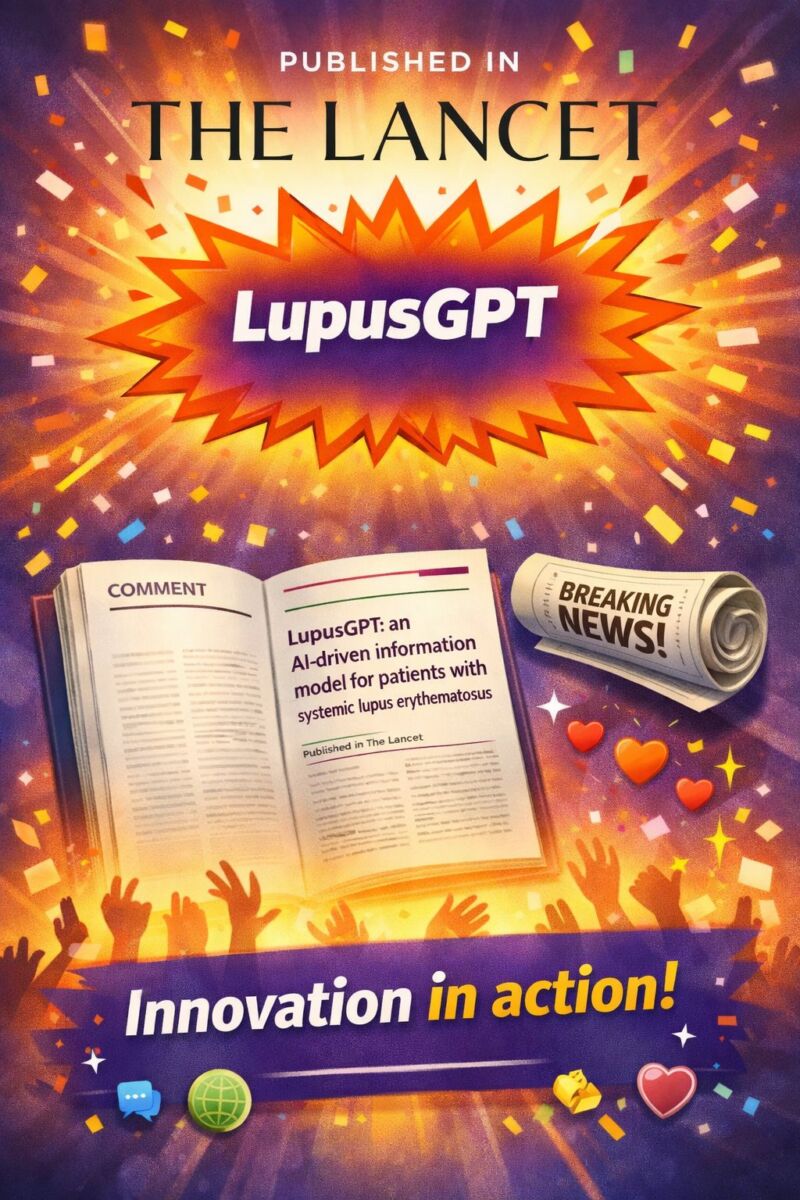
Watching Alain Cornet show the world what #LupusGPT really is still gives us goosebumps! 🙌

For those who still don't know this artificial intelligence tool:

💡 LupusGPT is built by patients and doctors.
🗣️ It speaks virtually any language.
💸 It’s free and anonymous- you don’t need to create an account.
📚 It is trained exclusively on a curated repository of validated documents.
🚫 It does not invent answers.

If something is not in the repository, LupusGPT will clearly say so. It will not guess. It will not generate false information.

🥹 Seeing LupusGPT presented at such a high-level regulatory forum confirmed something important:
Patient-led innovation can meaningfully contribute to the future of AI in medicine when it is built responsibly.

🔗 Try it here! lupusgpt.org/

🧠 Are medical terms confusing? Prefer shorter explanations in simple language?
Try #EasyLupus! The easy-read version of LupusGPT: easy.lupusgpt.org/
... See MoreSee Less

LUPUS EUROPE Uniting people with Lupus throughout Europe
Send