 Alain Cornet
My story – by Yvonne from the Netherlands
On 6 July 2004, I woke up with a tremendous pain in my right hand. Because I also had a slight rash, my GP immediately referred me to a dermatologist. He examined me and referred me to a rheumatologist because he had a hunch what might be wrong.
Fortunately, my rheumatologist was not only very friendly, but she also immediately knew what to look for. I gave blood and a urine sample and after a few weeks I got the answer.
It turned out I really had a disease, but whether that made me any wiser? I had Systemic Lupus Erythematosus. What sort of disease was that? Had anybody ever heard of that? I got a leaflet explaining what lupus is, what it is like to have it and what the symptoms can be. I started reading the leaflet, but chucked it away halfway through. I suddenly dawned on me that I had a chronic illness, an illness that couldn’t be cured. That I would never get better, that things would only get worse and that I might even die from it. I really didn’t need to see all that confirmed in a leaflet. However, after a couple of days/weeks, I picked up the leaflet again and started reading it in a different way. Although it listed all the things that could be affected, this mostly didn’t apply to me at all, so things seemed not too bad after all. Okay, I had lupus, but with the right medication I could live with it.
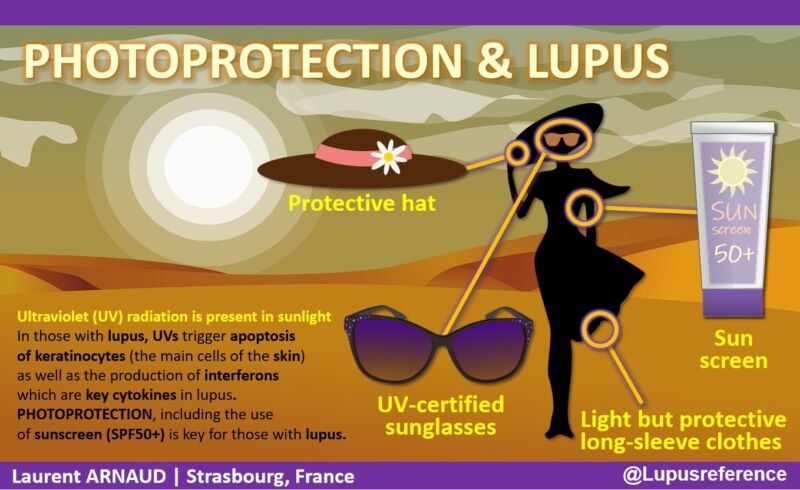
After a couple of months, I gradually returned to work. I was still processing all the new information and trying to accept the fact that my body was betraying me. Especially in the first few years, I fought against myself and my body. I was constantly testing my boundaries and crossed them fully and forcefully, refusing to accept the fact that there were certain things I was no longer able to do, or not in the same way as before. I was determined to show my body who was the boss! Painkillers are wonderful: I took at least two a day at first and up to 11 later on. They allowed me to go on/work as usual until I could no longer cope even with those 11. I had to admit defeat: my body had won again. I had to recover at least three weeks before I could gradually return to work. This fight took a number of years but eventually the penny dropped and I managed to find my balance. Especially when, after four years of being subborn, I thought I didn’t need sun protection and had another flare-up as a result.
Acceptance is hard, in particular because your body sometimes seems 40 years older than you are. Accepting that your body is betraying you is a kind of grieving process: you say goodbye to the body you once had and have to get used to another body instead, one you don’t know yet. You don’t know what to expect and that takes time. I was lucky that I was able to keep my two jobs, with some adjustments.
Eight years after being diagnosed with lupus, I had a mild heart attack. Was there a connection with lupus? Yes, posssibly.
Two years after this, I ended up in hospital again following months of terrible stomach pains without any clarity about what caused them. I had a very bad year with three bowel infarctions. Apart from being a lupus and heart patient, I was now also diagnosed with APS. Yet another set-back with major consequences – I have been declared fully incapacitated for work – but also a new challenge.
Looking back on the past few years, I know that I have changed, that I have had to give up a lot, but also that I more often put my own interests first. Some people find this selfish. Going out for an evening during the week? As little as possible, because I can’t cope with that anymore. It is only possible if I rest a lot in the days before and after. Getting up early? Only if strictly necessary; I really do need my sleep and rest. Going to a party? Only if it is really fun and I really want to go. Otherwise I don’t think it is worth the trouble of going to bed early an entire week in advance and spending the next day flat on the sofa.
So I make more conscious choices. In retrospect, the wheelchair, which I refused initially, gave me a lot of freedom. I wish I had accepted it earlier. I can’t work anymore. That is a pity, but at the same time it also a relief. No longer having to get up while not 100% fit and doubting whether to report sick (again) or try and go to work. Now, such a day is simply a day on the sofa. Unfortunately, this also means I sometimes have to disappoint people, that some people don’t understand and that I have lost “friends”. But am I unhappier now than in 2004, when I thought I was healthy? I don’t think so.
I live differently and more consciously. I am more aware of my body and of the choices I make and how the disease fits into my life. I know who and where my friends are. I have eliminated people who have not been there for me from my life. Of course I am sometimes angry or sad, exceed my boundaries and ask myself “why me?”, but that is okay, that is only human. I am happy with my way of life. I have been able to give lupus a place in my life. I have learnt to listen to my body and to realise that my body is usually calling the shots. Even if I have an incurable disease, this does not mean that I won’t live to 100 and that I can’t enjoy life.
I am who I am. I am Yvonne and I have a chronic illness: lupus/APS.
Translation: Petra Bernards
Yvonne is a member of NVLE – Nationale vereniging voor LUPUS, APS, Sclerodermie en MCTD