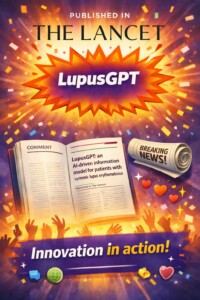
Celebratory graphic announcing LupusGPT’s publication in The Lancet, with confetti, an open journal, a “Breaking News” newspaper, raised hands, hearts, and the words “Innovation in action!”


We are very proud to share that LupusGPT has now been published in The Lancet Rheumatology, one of the world’s leading medical journals in rheumatology.

For us, this is not only about a publication. It is about what LupusGPT stands for.

LupusGPT is free. It is patient-led. And it was built to help people living with lupus find reliable, accessible information in almost any language.

It began with a simple but important question: what could become possible if patients, clinicians, and digital experts truly worked together from the start?

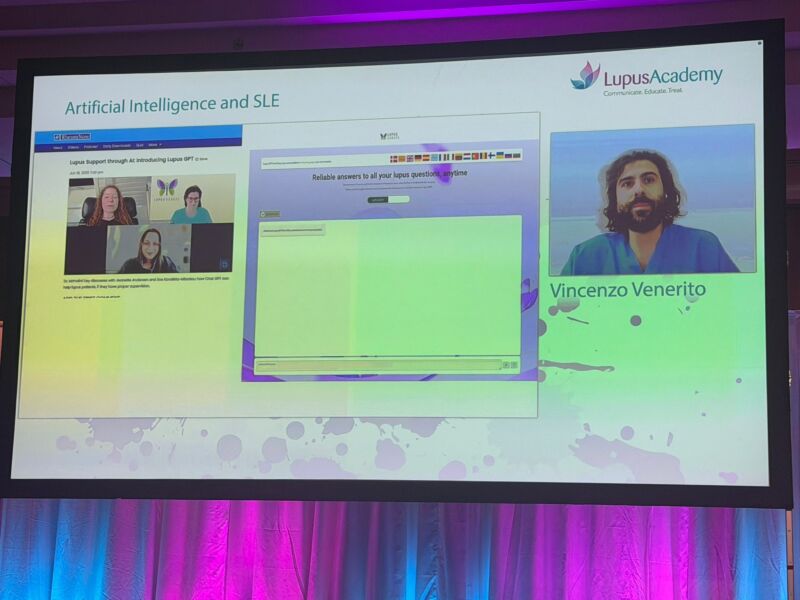
That question was first opened up in a fishbowl discussion at the European Lupus Meeting 2024 on how the lupus community could get the best, but not the worst, out of AI. From there, LupusGPT was shaped through the care, intelligence, and effort of many people: volunteers, patient testers, clinicians testing across languages, people who gave feedback, and people already helping us share it with patients in clinics, organisations, and communities.

This publication matters because it shows that patient-led innovation belongs in the scientific world too. It shows that when patient voice is not added at the end, but built in from the start, something real can grow.

A heartfelt thank you to all authors: Zoe Karakikla-Mitsakou, Alain Cornet, Jeanette Andersen, Sarah Dyball, Cristiana Sieiro Santos, Daniel Guimarães de Oliveira, and Laurent Arnaud. Special thanks also to Daniel Guimarães de Oliveira for the thought, care, and belief he brought to this work, and to Professor Laurent Arnaud for his outstanding support, steadiness, and guidance.

And above all, thank you to everyone in the LUPUS EUROPE community who keeps showing us why this matters.

LupusGPT. Free. Multilingual. Patient-led. And now part of the scientific record.

You can read the publication here:

https://doi.org/10.1016/S2665-9913(25)00370-4

The article is completely free to access with a simple, quick registration.

Live Facebook Feed

Comments Box SVG iconsUsed for the like, share, comment, and reaction icons

🧠 As lupus specialist Prof Laurent Arnaud clearly states, “Your experience of brain fog is real. It is common. It deserves attention.”

That is why the Lupus Brain Fog Severity Scale (LBFSS) was developed: to provide a lupus-specific way to assess the severity and impact of brain fog and related cognitive symptoms.

Importantly, people living with lupus were not simply asked to approve a finished questionnaire. Their own descriptions of brain fog were the starting point for its development.

🎥 Watch Prof Laurent Arnaud and our Chair, Jeanette Andersen, explain how people living with lupus helped shape the #LBFSS from the very beginning.

🦋 Lupus Europe is proud to have contributed to this international work and to have supported meaningful patient involvement throughout the development process.

📖 Read the study:
lupus.bmj.com/content/13/2/e002148
... See MoreSee Less

‼️Today is #WorldSjogrensDay, a chronic autoimmune disease that affects 14-17.8% of #lupus patients.

💁‍♀️ Although Sjögren's is a systemic disease that goes far beyond dryness, dryness remains a frequent, significant and disabling symptom.

➡️ Follow Sjögren Europe to know more.
... See MoreSee Less

‼️Today is #Worl

🧠 Brain fog is real.

For many people living with lupus, it affects everyday life, yet it has often remained difficult to measure.

✅ The new Lupus Brain Fog Severity Scale (LBFSS) is the first questionnaire designed specifically to assess brain fog in lupus.

🦋 Lupus Europe is proud to have contributed to its development through meaningful involvement of people living with lupus. It's another example of how patient perspectives help shape better research and better tools.

🎥 Watch Prof Laurent Arnaud and our Chair, Jeanette Andersen, explain why the LBFSS is such an important step forward in lupus care.

lupus.bmj.com/content/lupusscimed/13/2/e002148.full.pdf
... See MoreSee Less

🦋 Understanding lupus is crucial for effective management and self-management.

💁‍♀️ Many of us know what lupus is, and we’ve been learning from trusted resources like #Lupus100 and #LupusGPT.

🤔 But… how much do we really know about SLE?
Do we know as much as we think we do?

𝐓𝐫𝐲 #𝐒𝐋𝐀𝐊𝐄 𝐚𝐧𝐝 𝐟𝐢𝐧𝐝 𝐨𝐮𝐭❗

🎯 SLAKE (Systemic Lupus Assessment score for Essential Knowledge) is a quick and easy online tool designed for people living with lupus to test their knowledge and learn more about the disease.

📝 44 questions, randomly selected from a pool of 394
⏱️ Around 15 minutes to complete
🌍 Available in 20 languages
📊 A score for each lupus domain and an overall knowledge score

💡 Whether you're newly diagnosed or have been living with lupus for years, SLAKE helps you identify what you already know and where there is room to grow. It is not about passing or failing. It is a chance to learn more and feel more confident when taking part in decisions about your health.

📣 The SLAKE study is still open! By taking part, you are helping researchers understand which aspects of lupus are well understood and where important knowledge gaps remain.

These insights could help guide the potential development of better information resources and tools, tailored to the real needs of people living with lupus in different countries and regions.

SLAKE has been made possible thanks to the leadership of Prof Laurent Arnaud and Dr Antonin Satrin, and the collaboration of an international team of lupus experts and patient representatives.

🥰 Lupus Europe has proudly contributed to this project since the very beginning, and we encourage people living with lupus worldwide to take part while the study remains open.

🔗 Complete SLAKE today and let us know what you think!

lupusresearch.limequery.org/775349
... See MoreSee Less

LUPUS EUROPE Uniting people with Lupus throughout Europe
Send