LUPUS EUROPE – PATIENTS ADVISORY NETWORK

People with lupus need new and better treatments to improve their long-term prognoses and their quality of life. We need a better understanding of the disease and its medical, social and psychological impact, so that effective plans can be put in place. LUPUS EUROPE strongly believes that such research can only take place with the active participation of people with lupus, and of patient organisations.

To understand how we can best progress, LUPUS EUROPE organised a workshop session with Doctors and Scientists engaged in research, with other patient groups and non-profit organisations actively engaged in this area; and with representatives of the pharmaceutical industry engaged in Lupus related research. In addition, it gathered input from its members through a survey. These various initiatives have converged to the conclusion that to achieve the most meaningful results, LUPUS EUROPE should establish a “Patient Advisory” Group as defined below.

The Mission

The Patient Advisory Network (PAN) is a team of 20 to 25 trained and energised experienced patients, living with lupus, appointed by LUPUS EUROPE to act as liaison and resource to value-adding scientific projects, clinical trials and other research related to lupus, including EULAR task forces, SLEuro initiatives and ERN Research. They structurally connect the patient community to the scientific community. They provide prompt, reliable and consistent advice and support from the very initial stages of research all the way to effective access through treatment plans.


If you are interested in working as part of  LUPUS EUROPE PATIENT ADVISORY NETWORK, or have projects that would benefit from our support, contact LUPUS EUROPE’s secretariat (secretariat@lupus-europe.org)


Live Facebook Feed

Comments Box SVG iconsUsed for the like, share, comment, and reaction icons

🇵🇹 What a week at the European Lupus Meeting 2026 in Lisbon!

You may have noticed something unusual…

🤫 Lupus Europe has been very quiet on social media throughout the Congress.

The reason? We were way too busy contributing, participating and engaging throughout #Lupus2026!

Here are just a few highlights of Lupus Europe’s involvement:

🔹 12 Fishbowl Chairs
🔹 9 abstracts supported by Lupus Europe
🔹 Our Chair, Jeanette Andersen, speaking at both the opening and closing ceremonies
🔹 6 Lupus Europe co-chairs at scientific sessions
🔹 3 interventions in sessions and interactive workshops

🚀 Beyond the scientific programme, the meeting was also completely full of valuable discussions and working meetings for ongoing projects that we are excited to share with you soon.

Over the coming weeks, we will share more about what happened in Lisbon, so keep an eye out for news!

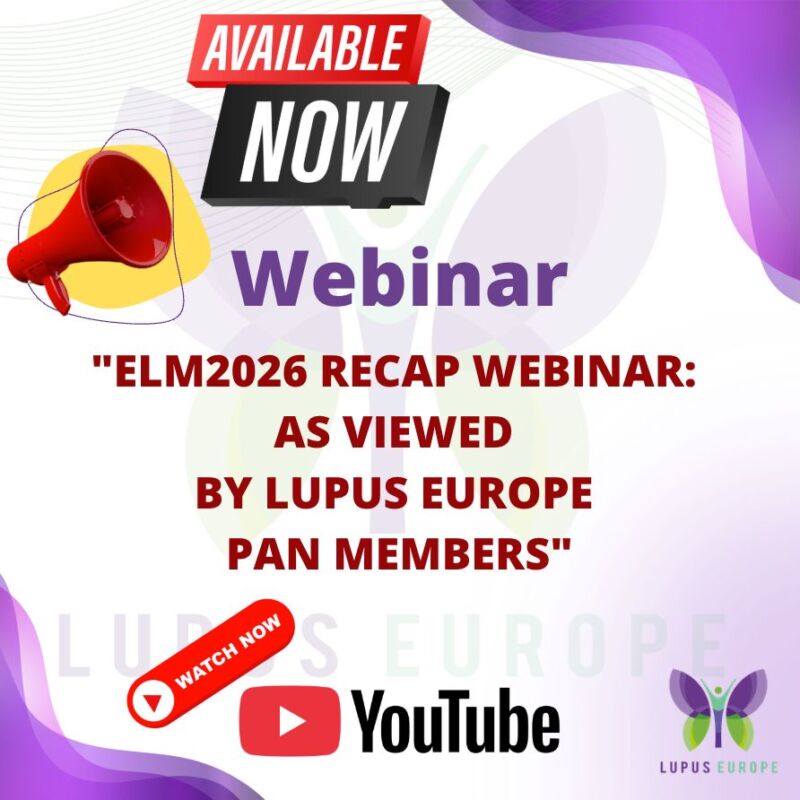
📅 Meanwhile, don’t miss our ELM 2026 Recap Webinar as viewed by our PAN members, who were there!
🗓 16 March
⏰ 19:00 CET (i.e. Paris time)
💻 Zoom

Register now, to hear the key takeaways and highlights from this important European meeting.
Just email: secretariat@lupus-europe.org
... See MoreSee Less

🇵🇹 What a week

Today is rare disease day!

🚨 There are over 300 million people who live with a #raredisease in #europe.

🌎 Today, we join our fellow patient organisations that work towards a better life for people with rare diseases and their families.

🔴 Some facts about #rarediseases:

1️⃣ There are more than 6000 identified rare diseases.

2️⃣ Rare diseases currently affect 5% of the worldwide population.
The true impact of rare diseases is much wider, however, with those affected in Europe in the millions, as the disease affects not only the patient but also our loved ones.

3️⃣ 72% of genetic diseases are genetic, although #lupus is not one of them.
👉 Lupus is not a genetic disease. Although it is very much related to genes, there are other factors that play a role in its manifestation.

4️⃣ 👶Neonatal #lupus is a rare congenital disorder that some infants of mothers with lupus and anti-Ro/SSA and/or anti-La/SSB antibodies develop.
The most serious complication of neonatal lupus is a heart condition known as congenital heart block.

5️⃣ Having an early diagnosis is key to having access to the right treatment. This has an impact on physical and mental health and, therefore, on the quality of life.

Along with organisations like Rare Disease Day and EURORDIS-Rare Diseases Europe, we will carry on working towards an early diagnosis, access to treatment and equality for #raredisease patients 🙌.

Thank you for your support on this #rarediseaseday!

#ShareYourColours
... See MoreSee Less

Image attachment
Image attachment
Image attachment
Image attachment
Image attachment

#lupus is a #raredisease that affects nearly 500,000 people in Europe. Furthermore, there are over 300 million people who live with a #raredisease in #europe.

Today, along with Rare Disease Day, patient organisations around the world advocate for equity for people living with a rare disease

#ShareYourColours and help us spread the word by liking and sharing. Remember that you can also download the material of the official campaign on the website

f.mtr.cool/iyctvzvvtj
... See MoreSee Less

#Lupus is a #RareDis

Today is #RareDiseaseDay!

And we have joined Rare Disease Day campaign.

Everyone deserves equal opportunities, access to healthcare ➕ early diagnosis, which is key to setting a treatment plan &, hence, achieving a good quality of life.
#ShareYourColours

www.youtube.com/watch?v=7J1oTfoIOGw
... See MoreSee Less

Today is #RareDiseas