Today is Rare Disease Day!

Lupus is a rare disease in Europe, although for those living with it, it doesn’t feel rare at all!

There are estimated to be less than five in 10,000 people in Europe who are living with lupus. Having a rare disease means that most people around you don’t have any idea what you are going through.


(Positive aspect of COVID and LOCKDOWN?)


Up until a year ago, living with lupus meant for some, living in fear and isolation. Some lupus patients take medication that suppresses their immune system to treat their lupus, but this can make people susceptible to infections. Lupus patients often live with the threat of another bug, another flare, another complication and never know what tomorrow might bring.  But today, there’s a new feeling almost of relief. People with lupus do not feel alone anymore!


Living in lockdown, with the threat of COVID-19 just outside the door, has brought up feelings of isolation and of being afraid of an invisible enemy for everyone. And while that is horrible and we wish it would stop as soon as possible for people everywhere, it is what some people with lupus may experience all the time. So today when we go out, masked, gloved, with our bottle of sanitising gel, no-one looks at us weirdly. When we avoid parties, or crowds, … for the first time ever we don’t have to explain or justify our behaviour.


Surprisingly, there have been positive aspects of this pandemic: the generalisation of remote working, telemedicine becoming a reality, remote ordering of medicines, more awareness of the effects of chronic diseases because of the awareness around “long covid” effects!  Perhaps you have some other examples?  Let’s make sure we are very clear about how much we appreciate those developments.  As lockdowns end and we push COVID to the back of our minds, let’s not forget the lessons we all learned during this time. Let’s all use this experience as a starting point for an ongoing conversation with your friends, your families, your healthcare workers, with society at large.  Let’s all discuss how to keep those improvements, while working together to end the isolation people with rare diseases often feel.


(LUPUS AND COVID VACCINES)

One step to getting out of lockdown is the COVID19 vaccination.  SLEuro (The European Lupus Society is a community of clinicians and researchers interested in SLE and related syndromes) has released a very useful Q&A document on the Covid vaccine for patients with SLE.  You can find it here: https://sleuro.org/sars-cov-2/


A lot of lupus patients around Europe have been vaccinated already, but many have not yet been offered a vaccine.  Each country has its own vaccination priority lists. Lupus gives automatic priority in some EU countries, not in others. What is the situation in your country? What are things like for you? Have you been vaccinated? Let us know by commenting under this post on our Facebook page and on Twitter!


(LUPUS RARE DISEASE)

Today is Rare Disease day. We should all be aware of two significant actors that help the rare disease community raise their voices in Europe: Orphanet and Eurordis

Orphanet is the portal for rare diseases and orphan drugs, a unique resource, gathering and improving knowledge on rare diseases so as to improve the diagnosis, care and treatment of patients with rare diseases. https://www.orpha.net/


EURORDIS is a non-governmental patient-driven alliance of patient organisations representing 956 rare disease patient organisations in 73 countries. https://www.eurordis.org/

Have a quick look on their websites and see what they are fighting for and doing for you!


(RARE 2030 RECOMMENDATIONS)

This week, the recommendations from the Rare2030 foresight study were released:


http://download2.eurordis.org/rare2030/Rare2030_recommendations.pdf


Rare 2030 is a proposal of EU policy recommendations that will bring improved policy and a better future for people living with a rare disease in Europe. This two-year project  was presented to EU Parliament last week with recommendations on the most critical areas needing better policy.

Here you can find information about Rare 2030: https://www.rare2030.eu


Please have a look at it and share it widely in your groups and countries. We will need to encourage our EU ministers to support it, so it’s good to learn as much as possible about it.


Use Rare Disease Day to start that conversation around you.


As they say: “Rare diseases are rare, but rare disease patients are numerous”.[/vc_column_text][/vc_column][/vc_row]
Live Facebook Feed

Comments Box SVG iconsUsed for the like, share, comment, and reaction icons

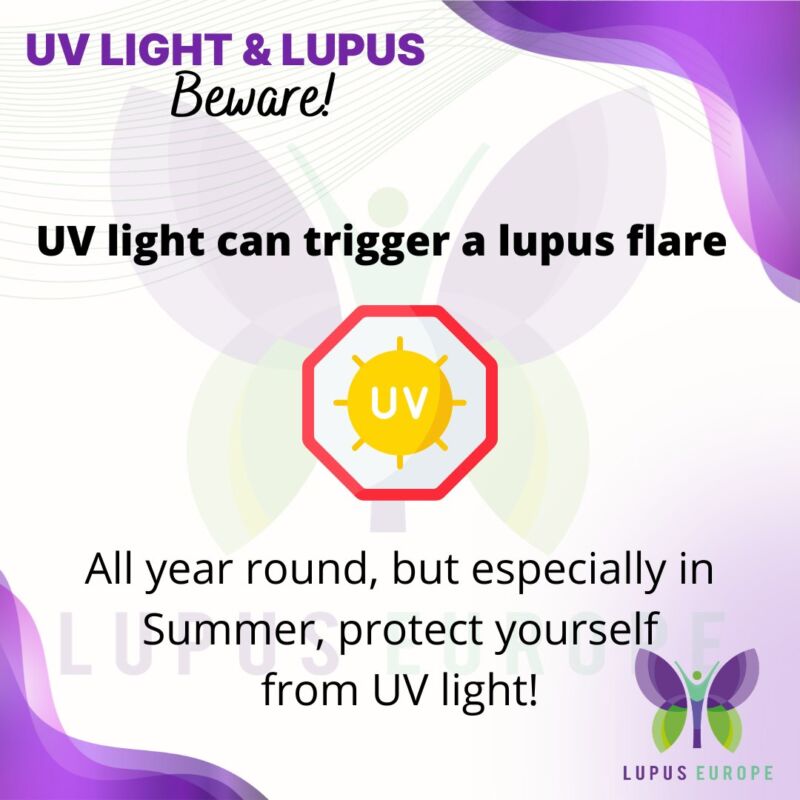
☀️ UV light and lupus: it is 𝗻𝗼𝘁 ❞𝗷𝘂𝘀𝘁 𝘀𝘂𝗻𝘀𝗵𝗶𝗻𝗲❞.

🔴 For many people living with lupus, sun and UV exposure can affect much more than Summer plans.

In the Lupus Europe Living with SLE in 2020 survey, photosensitivity was 𝗿𝗲𝗽𝗼𝗿𝘁𝗲𝗱 𝗯𝘆 𝟲𝟴.𝟱% of respondents.

😔 Furthermore, in Lupus Europe’s Swiss Knife Survey 2024, 25.8% of respondents said 𝘀𝘂𝗻 𝘀𝗲𝗻𝘀𝗶𝘁𝗶𝘃𝗶𝘁𝘆 𝗽𝗿𝗲𝘃𝗲𝗻𝘁𝗲𝗱 𝘁𝗵𝗲𝗺 𝗳𝗿𝗼𝗺 𝗹𝗶𝘃𝗶𝗻𝗴 𝗹𝗶𝗳𝗲 𝘁𝗼 𝘁𝗵𝗲 𝗳𝘂𝗹𝗹𝗲𝘀𝘁.

💥 The potential effect of the UV rays in lupus can influence when people go out, what they wear, how they plan holidays, whether they join outdoor activities, and how much they need to explain their choices to others.

𝗧𝗵𝗮𝘁 𝗺𝗮𝘁𝘁𝗲𝗿𝘀.

❌ Sun sensitivity may sometimes be seen as a “minor” symptom, but 𝗶𝘁𝘀 𝗶𝗺𝗽𝗮𝗰𝘁 𝗰𝗮𝗻 𝗯𝗲 𝘀𝗶𝗴𝗻𝗶𝗳𝗶𝗰𝗮𝗻𝘁. It can affect work, education, personal relationships, social life and mental wellbeing. It can also affect the people around someone living with lupus, from family and friends to colleagues who may not always understand why plans need to change.

Have questions about lupus and UV light?
Explore reliable information through #Lupus100 or ask #LupusGPT or #EasyLupus.

Swiss Knife Survey 2024:
f.mtr.cool/nsgolzfaek
... See MoreSee Less

☀️ UV light and

🦋 Our final #EULAR2026 recap is here!

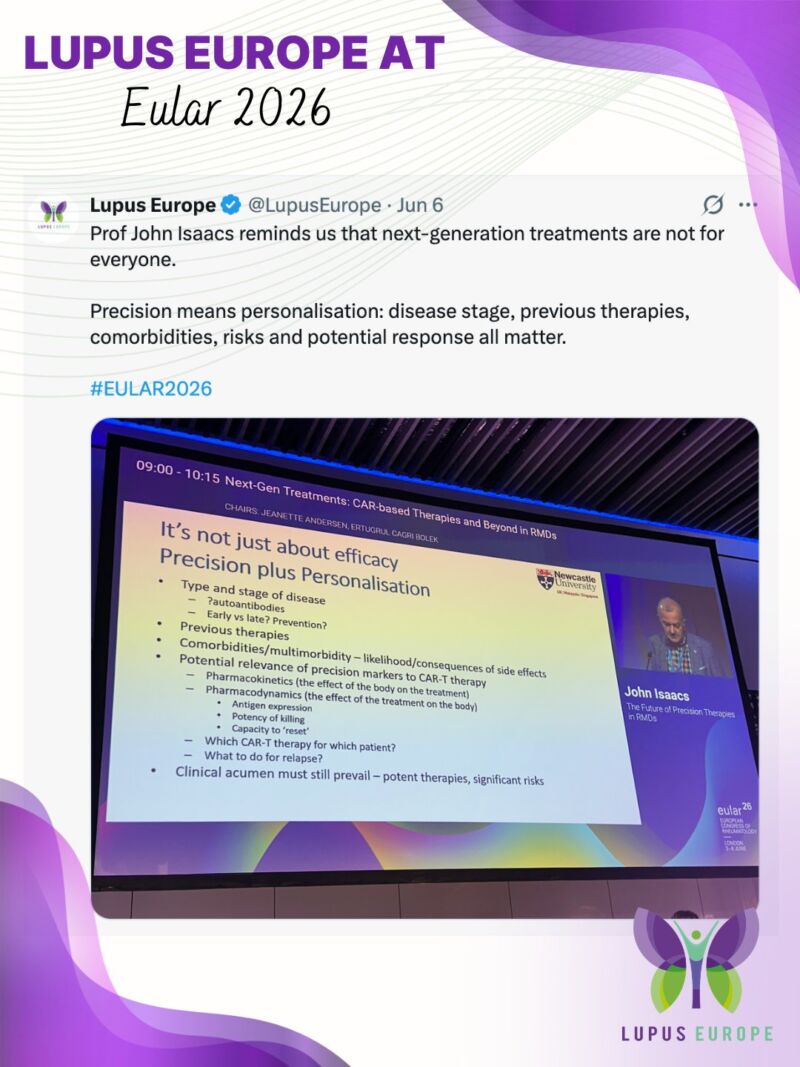
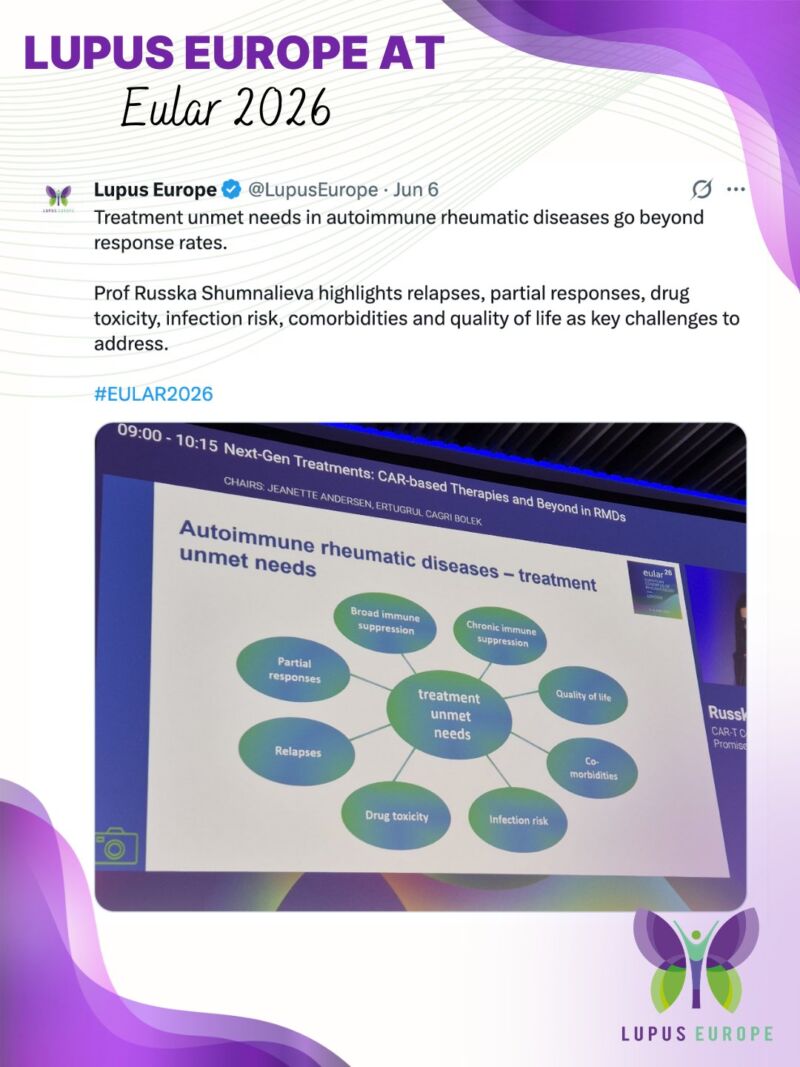
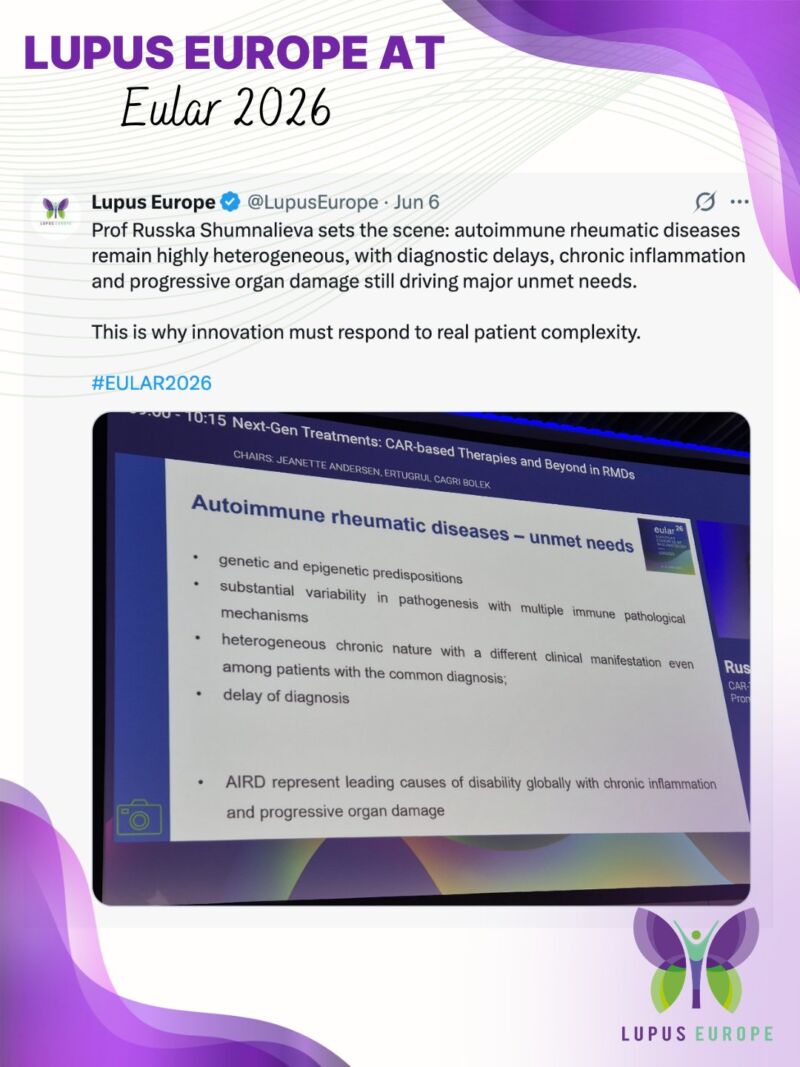
🌍 We started the day in the session “Next-Gen Treatments: CAR-based Therapies and Beyond in RMDs”, chaired by our Chair, Jeanette Andersen.

The session explored new therapeutic frontiers, but also the responsibilities that come with them. For us, one message remains essential: innovation must be developed with patients, not only for patients.

💬 Jeanette also delivered the PARE Meet the EULAR Expert session “AI as a Partner in Care: Empowering the RMD Community with Information”.

The room was packed, showing the strong interest around #LupusGPT and #EasyLupus as powerful patient-led, validated digital tools that help people living with lupus access reliable, understandable information in almost any language.

The many questions from attendees showed how relevant this topic has become for healthcare professionals, researchers, patient representatives and the wider rheumatology community.

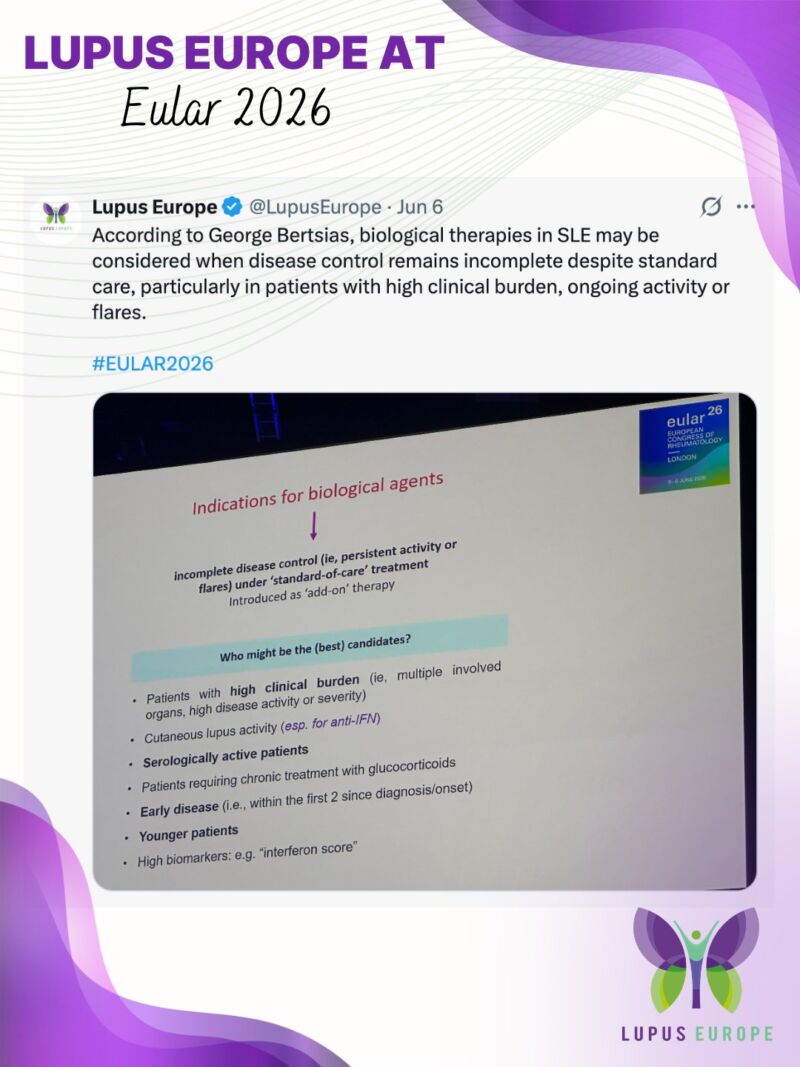
🧬 We also followed the “How to treat SLE” session with George Bertsias, who focused on current and evolving approaches in lupus care, including treat-to-target strategies, remission or low disease activity, and the importance of reducing long-term organ damage.

🦴 Later, Edward Vital led the Meet the EULAR Expert session on “Management of joint involvement in systemic lupus”, a topic that matters deeply to many people living with lupus.

💜 A special highlight of the day was seeing Lupus Europe’s work recognised during the EULAR highlights another year.

These sessions take place at the very end of the Congress and bring together the key takeaways from #EULAR2026. Importantly, there are no parallel sessions at that time, which means there is no competition with other talks, and most of the attendees are in the room.

🙏 Thank you to everyone who followed, shared, visited us, spoke with us and supported us throughout #EULAR2026.
... See MoreSee Less

Image attachment
Image attachment
Image attachment
Image attachment
Image attachment

🦋 We continue bringing you our #EULAR2026 congress recaps!

The third day was another intense day for Lupus Europe, with patient-led research, emerging science and important conversations about lived experience, as well as ongoing and potential projects to improve lupus care.

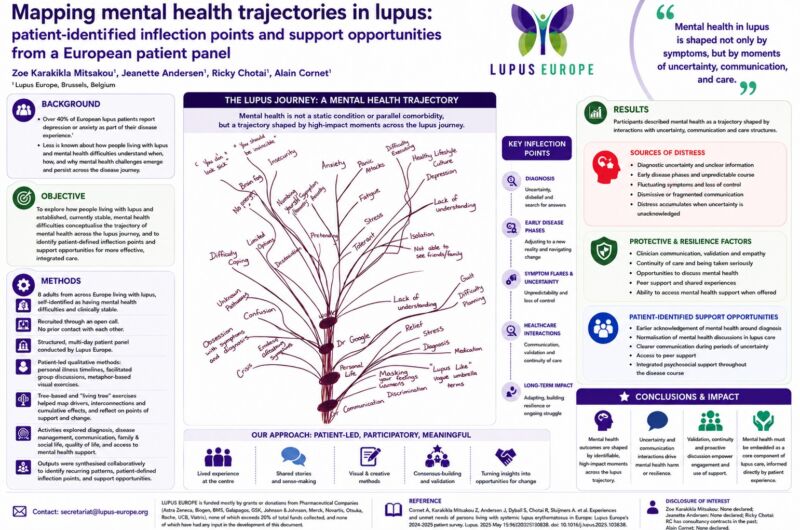
🧠 One of the highlights was Alain Cornet’s poster on mental health trajectories in lupus: “Mapping mental health trajectories in lupus: patient-identified inflection points and support opportunities from a European patient panel”.

Presented by Ricky Chotai on Alain’s behalf, this patient-led work explored how people living with lupus and mental health difficulties understand mental health across the lupus journey.

Yesterday, we already told you more about this poster and its key messages, in case you missed it!

🦠 On 5 June, we followed emerging science on the microbiome, and the Meet the EULAR Expert session “Management of joint involvement in systemic lupus” with Professor Edward M. Vital.

📊 Disease activity measurement in SLE was another important theme, especially how clinical targets can be better aligned with lived experience.

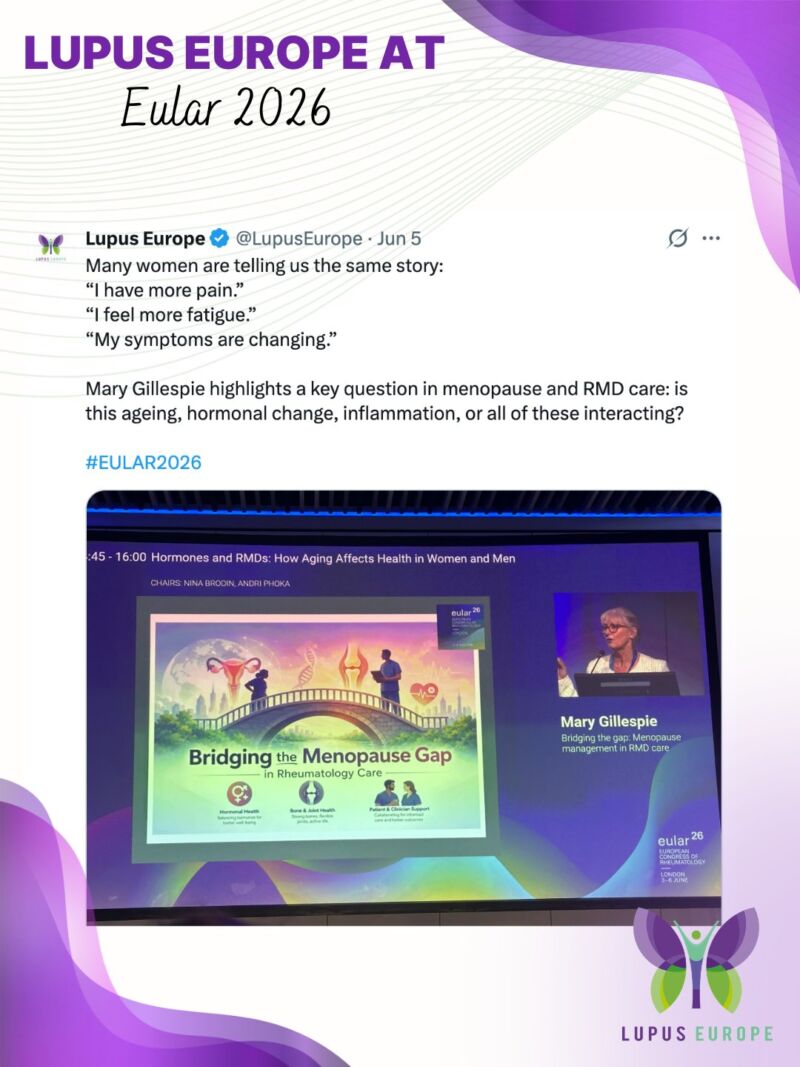
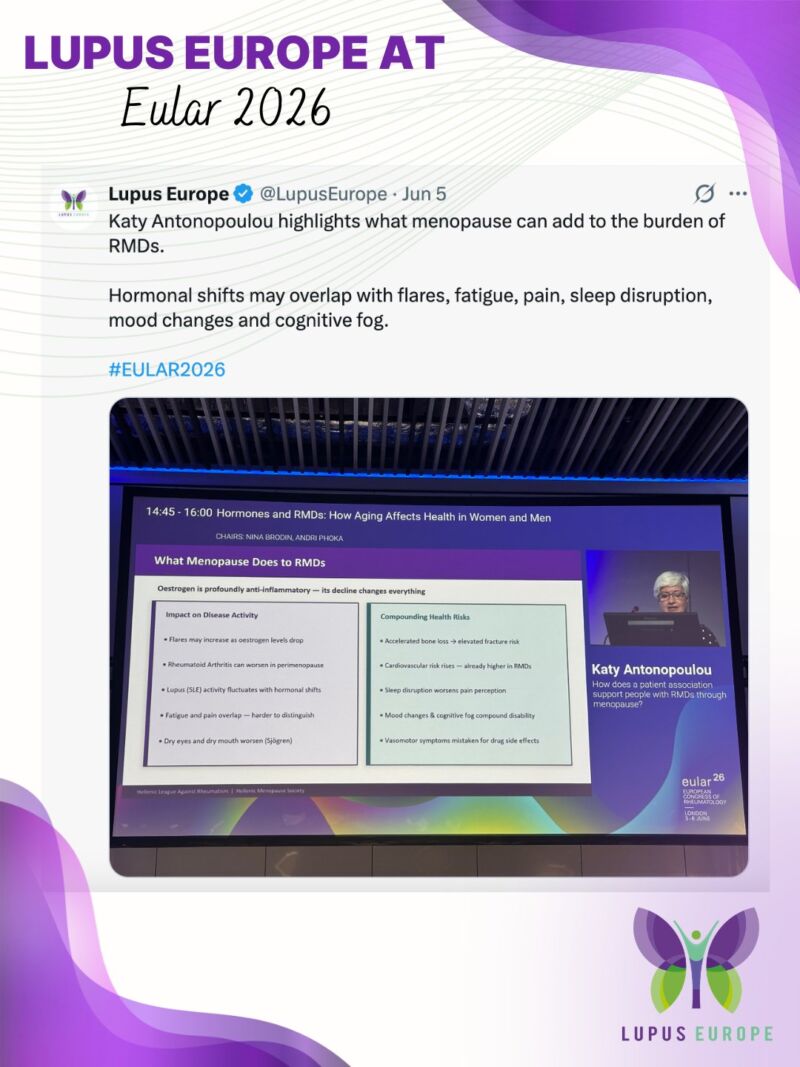
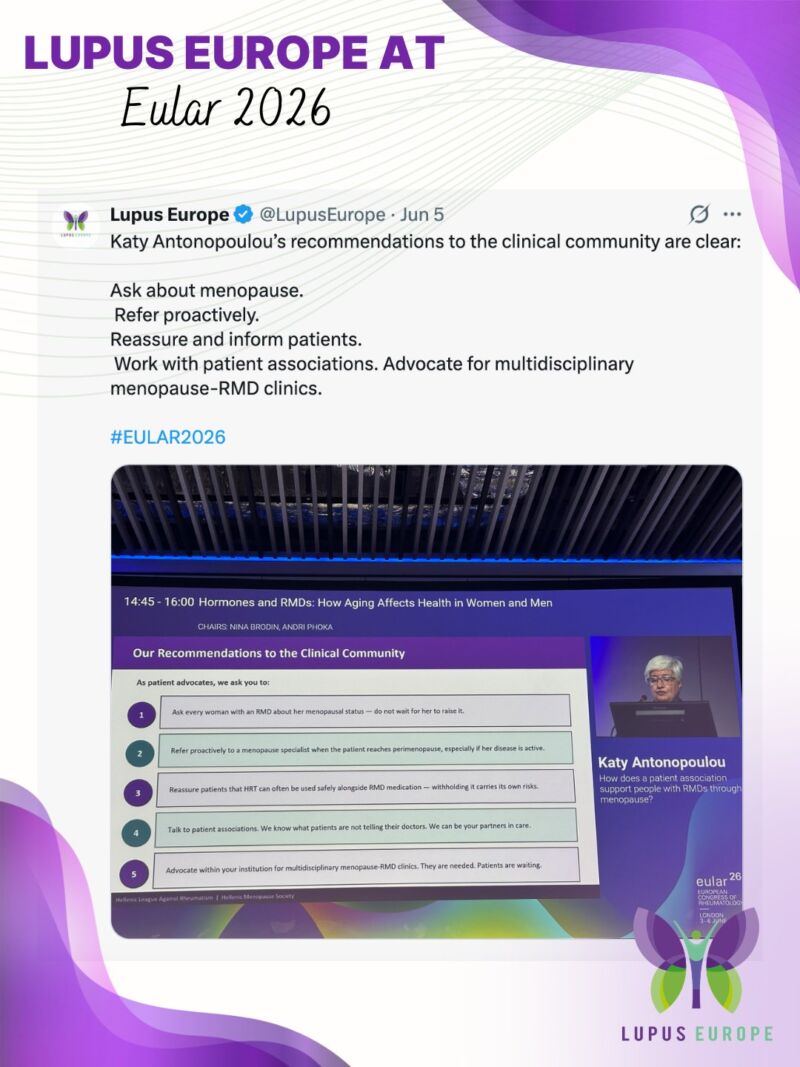
♀️ Menopause was part of the day’s conversations, highlighting the importance of asking about it routinely and recognising how hormonal transitions may shape symptoms and quality of life.

🌍 Across the day, one message kept returning: better lupus care needs science, but also communication, patient priorities and tools that help people say what matters most.

That is exactly why tools such as the Lupus Consultation Cards matter. They are available in 20 languages and help people prepare for their lupus appointments by organising symptoms, concerns and top questions in advance. Check them out here: www.lupus-europe.org/lupus-consultation-cards/

💬 We kept connecting these discussions with #LupusGPT and #EasyLupus, because access to understandable, reliable information before and after consultations is part of helping people take a more active role in their care.

🥳 And we celebrated Jeanette's birthday!

😃 Want to know more? Catch up on the latest insights from the congress in our #EULAR2026 Recap Webinar, which you can watch here: www.facebook.com/LupusEurope/videos/2035644043691260
... See MoreSee Less

Image attachment
Image attachment
Image attachment
Image attachment
Image attachment

😃 Last week at #EULAR2026, we presented POS0246-PARE, “Mapping mental health trajectories in lupus: patient-identified inflexion points and support opportunities from a European patient panel”.

The poster was presented by Ricky Chotai, Lupus Europe Board Member, on behalf of Alain Cornet, Lupus Europe Finance Lead & Organisation Coach, and lead author of this work.

✅ This patient-led qualitative work explored how people living with lupus and established, currently stable mental health difficulties understand the trajectory of mental health across the lupus journey.

‼️ Based on our patient panel conducted in Portugal with 8 adults living with lupus, the work identified key moments when support may matter most: diagnostic uncertainty, early disease phases, fluctuating symptoms, and communication with healthcare professionals.

🔴 One of the key messages is clear: mental health in lupus should not be seen only as an isolated symptom or crisis. It can be shaped over time by interactions with uncertainty, communication, and care structures.

The findings point to practical opportunities for support, including earlier acknowledgement of mental health concerns at diagnosis, normalising mental health discussions in lupus care, clearer communication during periods of uncertainty, peer support, and integrated psychosocial support throughout the disease course.

💫 Congratulations to Alain Cornet for this outstanding poster and to all authors: Zoe Karakikla-Mitsakou, Jeanette Andersen, Ricky Chotai, and Alain Cornet.

Read the abstract:
distribution-congress.eular.org/from.storage?image=15rRXWmdOAJ77zPlkD-rQtl85j9jAymUnt6XfjsO2C9rls...
... See MoreSee Less

😃 Last week at #E
LUPUS EUROPE Uniting people with Lupus throughout Europe
Send